When you open your electricity bill, you usually see one total. Maybe two: "electricity" and "grid fees."
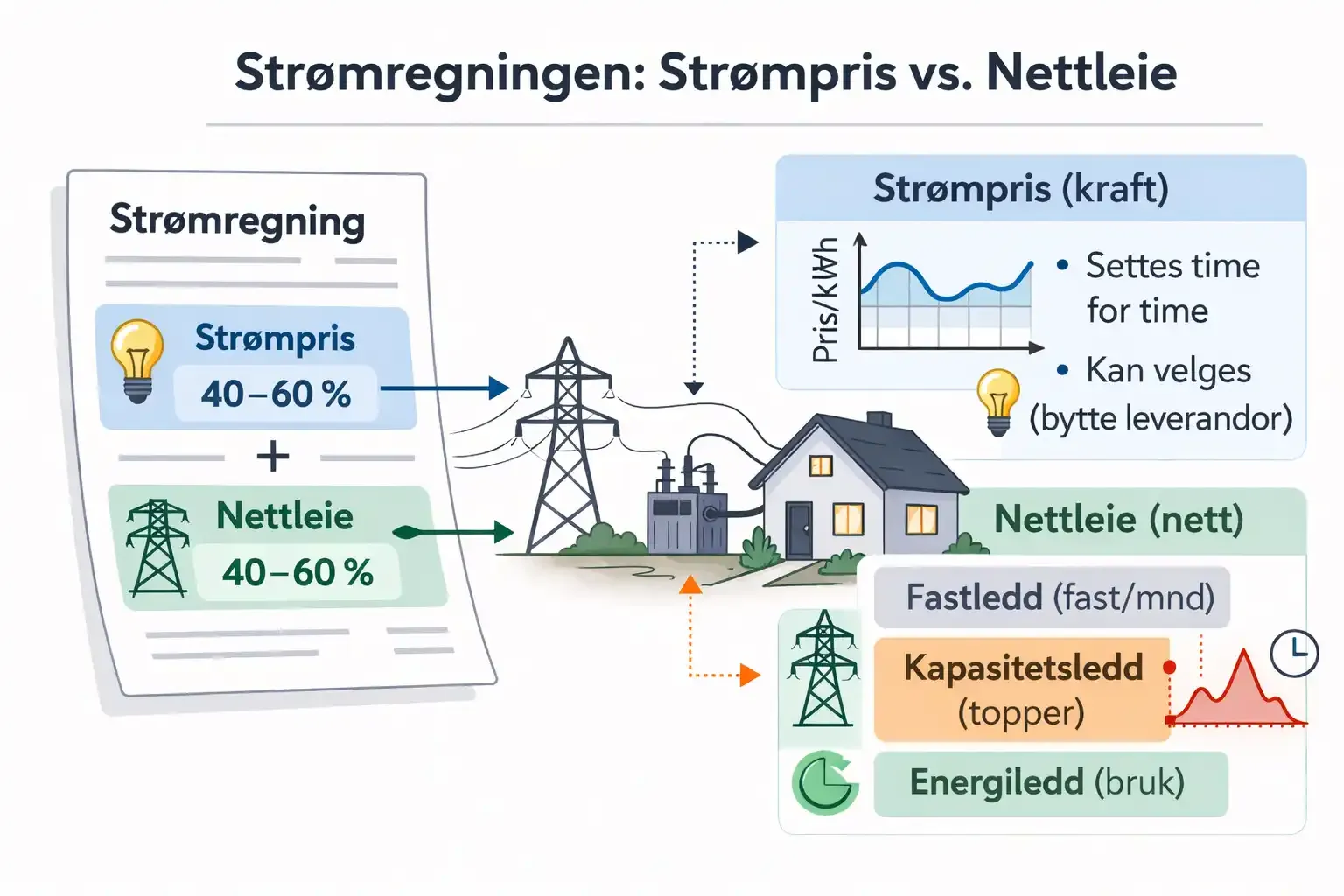
Most people focus on the electricity price. It is visible, it fluctuates, and it dominates the news. Butgrid fees- what you pay to have electricity delivered - often account for40-60% of the total bill.
Since July 1, 2022, grid fees have changed fundamentally.
The old system - where you paid a fixed price per kWh - has been replaced by a model that takes greater account ofwhenandhowyou use electricity, not just how much.
This article explains the entire grid-fee system from the ground up, what the capacity charge actually is, and what you can do to pay as little as possible.
01Grid fees vs. the electricity price: what is the difference?
Your electricity bill consists of two separate parts.
The electricity priceis what you pay for the electricity itself - the power you use. You pay this to your electricity supplier, such as Tibber or Fjordkraft. You can switch supplier, choose a contract type, and influence the cost by shifting consumption to cheaper hours.
Grid feesare what you pay to have electricity delivered to your home. You pay them to your local grid operator. The grid operator is a geographic monopoly - you cannot choose another one. What you can influence, however, is which capacity-charge tier you fall into.
02How grid fees are structured
Grid fees consist of three parts: a fixed charge, a capacity charge, and an energy charge.
1. Fixed charge
The fixed charge is a fixed monthly amount that everyone pays, regardless of how much electricity they use. It typically ranges from 100-300 kroner per month, depending on the grid operator and fuse size.
This part is not something you can influence. It covers basic costs for operating and maintaining the electricity grid.
2. Capacity charge
The capacity charge is the most important part to understand.
It was introduced on July 1, 2022, and is based on yourconsumption peaks, meaning how much electricity you use simultaneously within a single hour.
The grid operator looks at your three highest hourly readings during the month. It averages those three hours and places you in a capacity tier. Each tier has a fixed monthly price.
This means that just three individual hours can determine how much you pay in capacity charges for the entire month.
3. Energy charge
The energy charge is a variable price per kWh you actually use. It is often lower than before because more of the cost now sits in the capacity charge.
The energy charge also varies throughout the day. Typically, the price is higher during the day, for example between 06:00 and 22:00, and lower at night between 22:00 and 06:00. The difference can be significant, creating an opportunity to save by shifting flexible consumption to nighttime.
03Capacity tiers: what do they cost?
All grid operators use capacity tiers, but prices vary somewhat.
A typical model in 2026 might look like this in practice:
The lowest tier applies to homes with very low simultaneous consumption, for example an average of 0-2 kWh across the three highest hours. This may cost around 100-130 kroner per month.
The next tier, for example 2-5 kWh, may cost around 195-230 kroner per month.
The middle tiers, such as 5-10 kWh and 10-15 kWh, can cost from approximately 310 to more than 500 kroner per month.
The highest tiers, for example 15-20 kWh and 20-25 kWh, can cost between 560 and 850 kroner per month.
The difference between a low and a high tier can therefore be around 450 kroner per month - more than 5,000 kroner per year - simply because several large appliances were running at the same time a few times.
04How the capacity charge is calculated - step by step
Let us look at a concrete example.
A family in a detached house has an EV, a hot-water tank, and electric heating. In January, they normally use between 3 and 8 kWh per hour.
But three hours stand out:
One January afternoon, the EV is charging while the hot water is heating and dinner is being prepared. Consumption reaches 18.5 kWh that hour.
On a cold morning, underfloor heating, space heaters, and hot water run at the same time. Consumption reaches 16.2 kWh.
Something similar happens one afternoon, and consumption reaches 17.8 kWh.
The grid operator takes the three highest hours: 18.5 + 16.2 + 17.8. The sum is divided by three, giving an average of 17.5 kWh.
This places the home in a high capacity tier, for example 15-20 kWh. The result is a capacity charge of perhaps 600-700 kroner that month.
Even though nearly all other hours in the month were below 10 kWh, these are the three hours that determine the entire capacity charge.
05Grid fees by operator: how to check what you pay
You cannot switch grid operators, but you should know which one you have.
You can find the grid operator on your electricity bill or through the website of the Norwegian Water Resources and Energy Directorate.
Among Norway's largest grid operators are:
Elvia in Eastern Norway.
Glitre Nett in parts of Eastern Norway.
Lede in Telemark and Vestfold.
BKK Nett in Western Norway.
Linja in Southern Norway.
Tensio in Trøndelag.
On the grid operator's "My page", you can normally see which capacity tier you are in and which three hours have been highest so far this month.
06Why was the new system introduced?
The old model mainly charged for volume - how many kWh you used.
But for the electricity grid, total consumption is not the only thing that matters. It is how much is used at the same time.
If many people use a lot of electricity simultaneously - typically in the morning and afternoon - transformers and cables are heavily loaded. This requires a larger, more expensive grid.
The new system therefore creates a financial incentive to spread consumption more evenly throughout the day. You can use the same total amount of electricity but pay less if you avoid high peaks.
In short: The old system charged for volume. The new system charges for power.
07Grid fees throughout the year: seasonal variations
Grid fees vary throughout the year.
Many grid operators have higher energy charges in winter than in summer. Capacity tiers are usually the same all year, but winter often creates higher peaks because of heating.
November through March are typically the most expensive months. Cold days and dark evenings mean more heating, more lighting, and more simultaneous consumption.
One cold week can be enough to move you up an entire capacity tier for that month.
08Five common misconceptions about grid fees
The first misconception is that grid fees are completely fixed and impossible to influence. The fixed charge is fixed, but both the capacity and energy charges can be influenced through smarter usage.
The second is that low total consumption automatically means low grid fees. That is not always true. A household with low consumption but large peaks may pay more than one that uses more electricity evenly.
The third is that you can switch grid operators. You cannot. The grid operator is determined by where you live.
The fourth is that the electricity subsidy covers grid fees. The subsidy applies only to the electricity price above a certain threshold, not to grid fees.
The fifth is that the difference between the tiers is small. In reality, the difference can be several thousand kroner per year.
09New month - new opportunity
The capacity charge resets on the first day of every month.
That means even if one month was expensive because of a few peaks, you start with a clean slate the next month.
Three new hours determine the next tier. This gives you a continuous opportunity to improve.
10How Wattoshi helps you take control - and build Bitcoin value
It is exhausting to run around the house making sure you are not using too much electricity at the same time. That is where Wattoshi comes in.
Wattoshi connects directly to your electricity meter (AMS) and monitors power consumption in real time. By letting Wattoshi control some of your home's flexible loads - for example, the hot-water tank, an EV charger, heaters, or even a Bitcoin miner - the system takes over the tedious work completely automatically:
- Peak Shaving (cut your capacity charge):As soon as the home's total electricity consumption approaches an expensive threshold, for example because someone turns on the oven, Wattoshi temporarily switches off a flexible load such as the hot-water tank. You notice no difference in comfort, but avoid moving up a capacity tier. This alone can save thousands of kroner per year in grid fees.
- Smarter kWh consumption (save on the electricity price):Wattoshi also makes sure your flexible loads primarily use electricity when it is cheapest. Fewer expensive kilowatt-hours mean a significantly lower electricity bill.
- Turn savings into Bitcoin:This is the clever part. The Wattoshi dashboard calculates exactly how much you have saved in kroner and øre by avoiding high power peaks and expensive electricity periods. The system displays this saving as an equivalent value in Bitcoin (satoshis) on your screen. Otherwise invisible electricity savings are converted into growing digital value. Instead of paying more for unnecessary peaks, you can build up Bitcoin over time.
11Summary
Grid fees make up a large part of your electricity bill. Since 2022, a significant share has been determined by the capacity charge, based on your three highest hourly readings during the month.
It is not total consumption alone that determines what you pay, but how much you use simultaneously.
By:
- avoiding large appliances running simultaneously
- shifting flexible consumption to nighttime
- monitoring power consumption
you can significantly reduce your grid fees.
You pay for the grid no matter what. The question is whether you are paying for more capacity than you actually need.